
Features
A common core for every business, and modules to turn on for your activity.
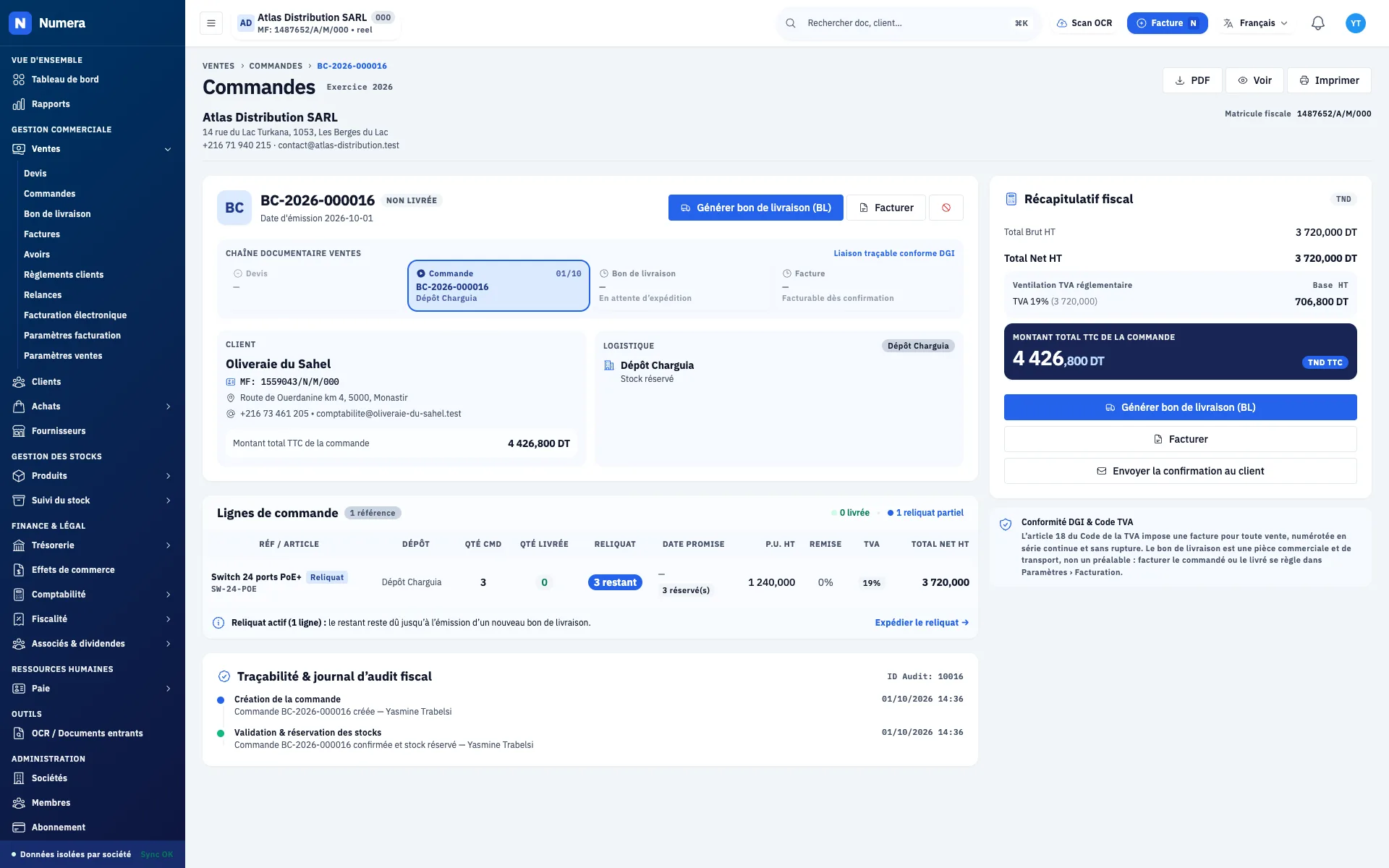
The document chain, on every document
Quote, order, delivery and invoice are linked: you see where a document came from and what is left to do.
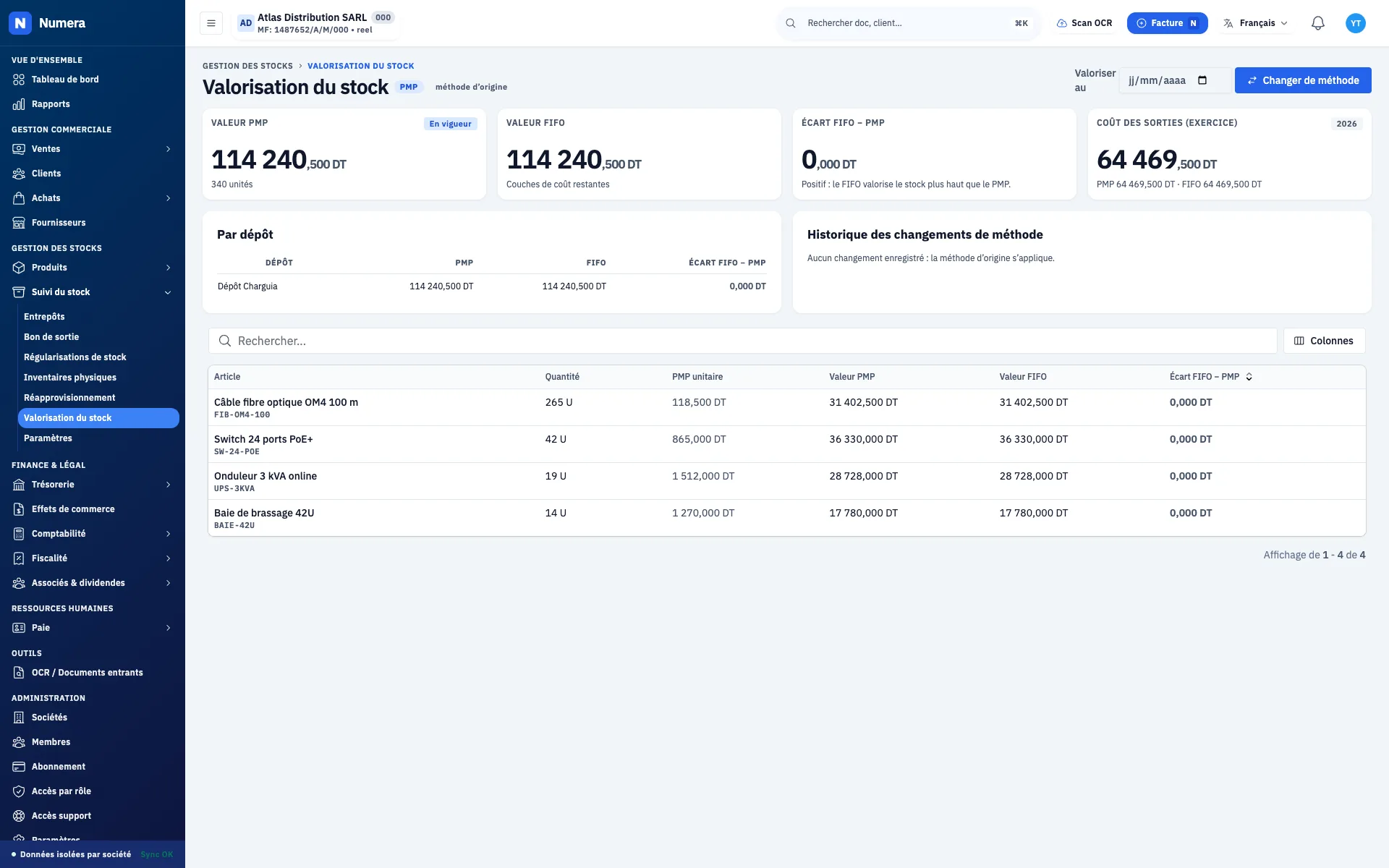
Stock valued to the millime
Weighted average cost and FIFO, computed on every movement, per warehouse and per item.
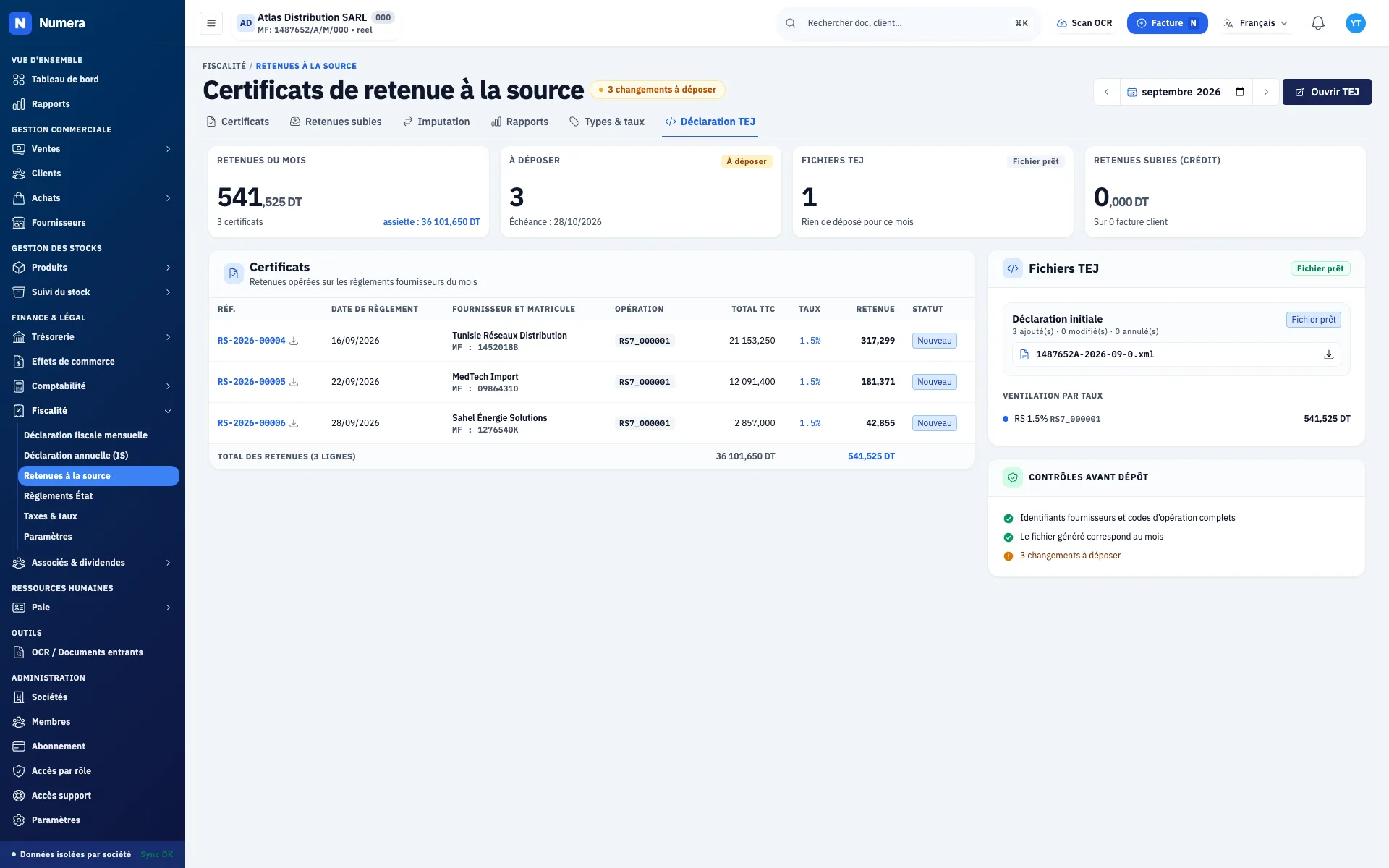
Your withholding tax, filed on TEJ
Every supplier payment produces its withholding certificate. At month end, Numera generates the TEJ return as an XML file: you upload it, record the reference, and the certificates are marked as declared.
Everything an SME needs
Turn on only the modules you use. They share the same customers, items and accounts.
Included in every plan Invoicing and treasury
Invoicing and collections
Invoices, credit notes, fiscal stamp, FODEC, multi-currency, payment tracking.
Customers and reminders
Customer file, outstanding, aged balance, automatic reminders by e-mail, SMS and WhatsApp.
Treasury and banks
Bank accounts, reconciliation, bank charges, forecast.
VAT and returns
Monthly return, corporate tax, tax calendar.
Modules
Quotes, orders, invoices, credit notes, customer payments and El Fatoora e-invoicing.
Products & services
Items and services sold or bought, prices, nomenclatures.
Supplier orders, receptions, supplier invoices and payments.
Stock tracked as you sell, delivery notes; depending on the edition: one or several warehouses, movements, counts, logistics, up to warehouses run by agents (Managed warehouse).
Transport (TMS)
Transport orders typed in or born from your delivery notes, drivers and vehicles, transport documents, proofs of delivery, returns and interventions, real-time tracking; in TMS Complete: delivery routes, delivery plan, routes map, cash on delivery and driver cash, return pickups, subcontracted carriers.
Treasury & banks
Bank accounts, cash position and schedule, reconciliation, currencies.
Tax & returns
Taxes and rates, monthly return, withholding and TEJ, corporate tax.
Bills of exchange receivable and payable, discounting.
Journals, entries, general ledger, trial balance, matching, aged balance, exchange differences.
Shareholder register, dividend advances and distributions.
HR management: payroll (payslips, CNSS, income tax, leave, returns), HR (agreements, employee space, time tracking) and talent (recruitment, training, evaluations).
Reading scanned invoices and orders.
Reminders
Automatic reminders of unpaid invoices by email, SMS or WhatsApp, scenarios, approval queue and follow-up per customer.
For the liberal professions: fee notes on a flat, hourly or success basis, disbursements re-billed outside VAT, retainer requests imputed on the note, compliant PDF.
An online space in your colours for your customers: a shop by category at their prices, orders for you to validate (or accepted by your rules), quotes accepted online, delivery tracking, return requests, invoices, credit notes, payments and account statement. Sold by number of customer accounts.
After-sales service
After-sales service: installed base with the warranty of every unit sold, service requests (intake, diagnosis, repair quote, parts and labour, return), replacement or refund through a customer return, repair invoice, tracked lead times and customer satisfaction — under law 92-117 (warranty) and law 2009-69 (after-sales service and spare parts).
Expenses without invoice
Expenses paid without a valid invoice — a taxi, a lunch with a client, a plumber or electrician paid by hand, a till receipt — recorded on the day with their proofs (photos, screenshots, PDF), then marked by the accountant “accounted” or “settled”, with his note. A receipt for the beneficiary to sign, Excel export and ZIP of the proofs for the accountant. No entry, no cash register touched.
CRM
Sales follow-up: prospects (source, status, owner, tags) converted into customers without losing their history, activities (calls, e-mails, meetings, tasks, notes) with reminders, a Kanban opportunity pipeline with weighted amounts, quotes created from an opportunity and chased automatically when left unanswered, reports by stage, by salesperson and by source.
Approvals
The company’s approval rules: which documents wait for a “yes” before their act — a purchase order above a threshold, the approval to pay a supplier invoice, a salary advance — who approves (roles or named members, in order or not), one or two approvals by two different people. “To approve” queue, bulk approval, rejection reason, reminders of overdue requests and the trail on each document.
Documents
The company’s library (document management): a tree of folders, visible to all or to some roles, drag-and-drop documents, versions kept and restorable, tags, expiry dates, links to records (customer, supplier, employee, vehicle, invoice…), preview in the browser, a trail of who filed, moved or deleted what, a restorable bin.
Signatures
Electronic signature of your documents: a quote, a delivery note, an employee’s contract or certificate, any PDF of the library. The PDF is frozen and its SHA-256 fingerprint kept; each signer receives a personal link, confirms their identity with a one-time code (email, or SMS with a pack), draws or types their signature. Signing order, reminders, expiry, reasoned refusal; signed PDF (signature page, fingerprint on every page) and signature certificate filed in the library. Certified signature through an accredited provider as an option.
Ready to simplify your management?
Create your account in two minutes and try every feature of your plan for free. No credit card. Your data can be exported at any time.